
Cooperative History
Image
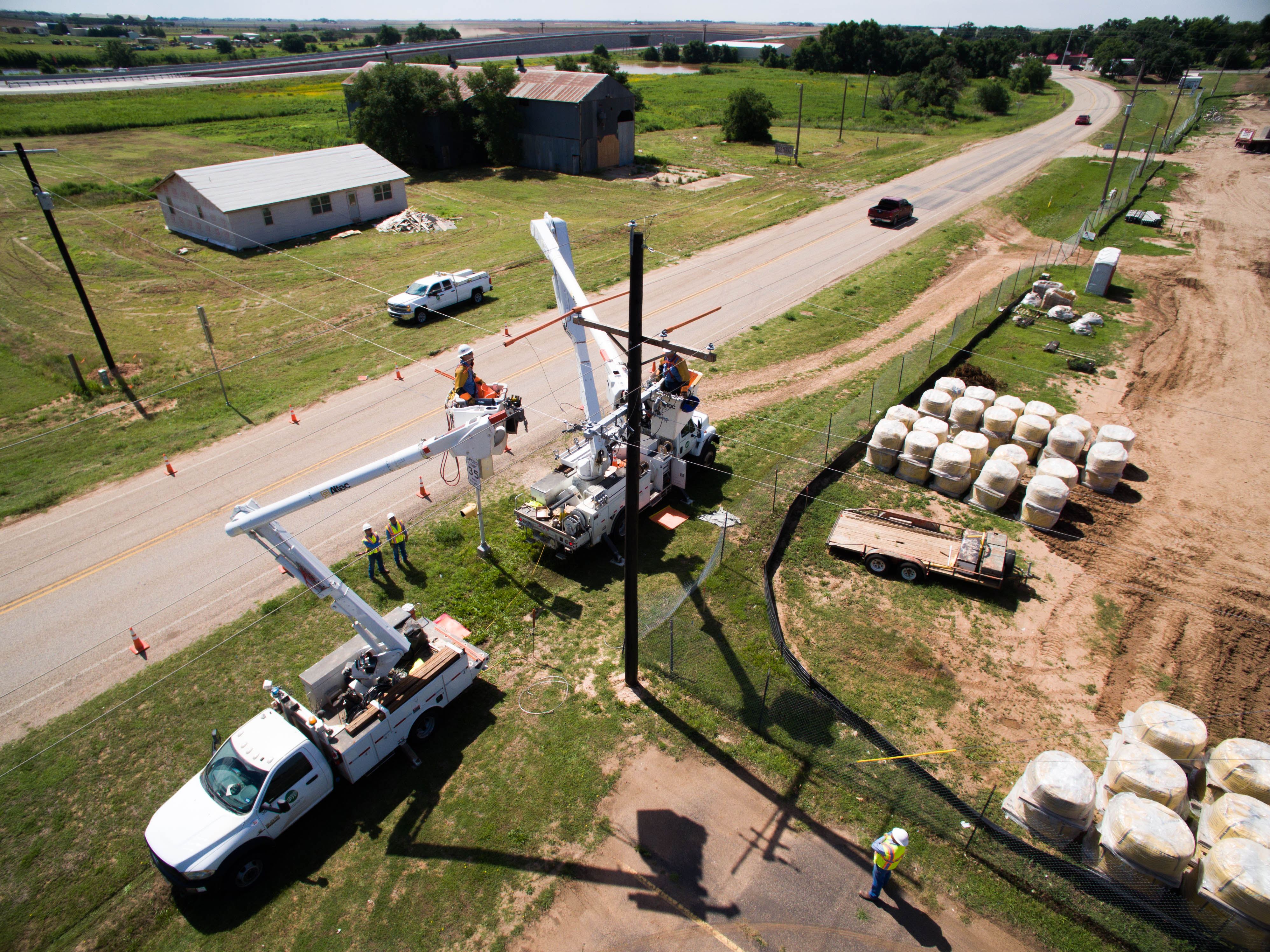
Celebrating the Cooperative
In 2027, South Plains Electric Cooperative will be celebrating 90 years of serving our members!
In 2027 we will celebrate our 90th anniversary. We are proud to serve our members since 1937 and look forward to continuing to provide outstanding electric service and benefits to our community for years to come. We invite you to learn more about South Plains Electric Cooperative.
Image

Dickens Electric Cooperative (DEC) was born from the dreams and desires of area pioneers. Although DEC was not one of the original businesses when the City of Spur was established, it has become an important part of the community.
The possibility of providing electrical energy to rural areas by an electric cooperative was first discussed by Mr. Joe Rose and Mr. John Sharp in late 1939.
Image
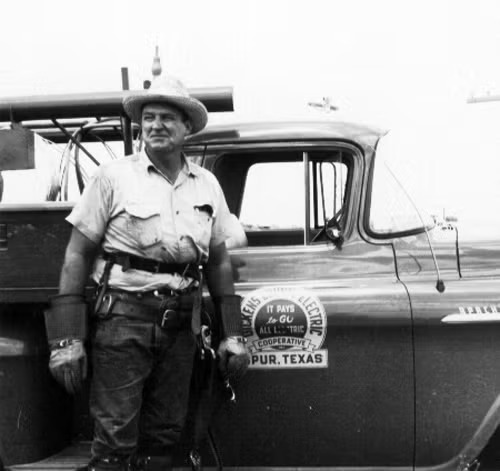
One of the first items concerning the establishing of an electric cooperative was a letter dated December 19, 1939, to Mr. C.O. Falkewald, who was with the examing division of the Rural Electrification Administration (REA), Washington, D.C., from Mr. L.D. Ratliff, Jr., of Spur, Texas.
Mr. Ratliff, then county attorney, stated that he had been designated correspondent for a committee of farmers who were interested in rural electrification in Dickens, Kent and Motley counties. One of the first steps in organizing a cooperative was to select and receive approval for a project attorney from the legal department of REA. Also, nine men were to be selected to act as original incorporators. A charter also had to be acquired from the State of Texas. The nine appointed original incorporators of the newly organized cooperative were Mr. Joe Rose of Roaring Springs, president; Mr. J.P. Sharp of Spur, secretary; Mr. C.V. O'Keefe of Girard; Mr. E.J. Offield of Afton; Mr. W.H. Hindman of Spur; Mr. M.B. Gage of Afton; Mr. E.F. Shugart of Spur; Mr. W.B. Lang of Jayton and Mr. Les Smith of Roaring Springs.
Mr. Ratliff was appointed project attorney and filed for a charter with the secretary of the State of Texas. This charter was granted on February 10, 1940. The newly appointed board held its first meeting February 24, 1940, L.D. Ratliff's office in Spur Security Bank. The chairman reported that the original copy of the Articles of Incorporation was filed on February 10, 1940, and the secretary of state had issued a Certificate of Incorporation.
This Certificate of Incorporation authorized them to start soliciting members. They held meetings in school buildings and signed up anyone in the rural areas of Dickens, Kent, Stonewall, King, Motley, Crosby and Garza counties who was not already receiving electric power from another source, was willing to sign an easement and pay $5 for the membership fee. Prospective members also had to own a certain number of cows, hogs, chickens or sheep so that paying their bills would be feasible. Mr. W.H. Hindman, also a member on the board of directors, has the honor of holding the first membership.
During this time, Mr. H.M. Roberts was selected by the board of directors as the project engineer. His job was to take the membership applications and map the residences signed up, and also the ones which were not, designating the homes which were to receive electricity.
The Cooperative's first loan application was submitted to the REA in March 1941. Approval of this loan was finally granted in December 1941. However, because of the outbreak of World War II, the Cooperative did not receive loan funds until 1944.
When the war was finally over, Mr. Robert Kuykendall was hired as the first manager in November 1944 and the Dickens County Electric Cooperative moved into its first office during the same month. The office was located in the Roy Stovall Building from 1944 until 1956.
Mrs. Helen Williams was hired in November 1944 as the first cashier. Of the first office, she remembers that they had no pencils, one typewriter, no screens on the doors, but plenty of flies. Although everything was seemingly ready to begin, there still were not enough people signed up as members in order that the loan might be received. Postwar poverty did not help matters any. Mr.Ratliff had this to say about the difficulty of the times: "Times were hard. We couldn't get people to pay the $5 membership fee because they just didn't have $5. Also, they just didn't believe they could ever get electricity."
Finally enough people did sign up for membership, and the first loan was received on November 21, 1944. In the meeting of the board of directors on that same day, bids for the construction of 75 miles of electric line were received. The bid for $57,629.38, submitted by the Eugene Ashe Electric Company, was accepted, it being the lowest. Construction soon began on the first line, erected east of Spur.
Just when everything was running relatively smoothly, Mr. Kuykendall reported in a board meeting on March 3, 1945, that he was being drafted into the armed services, and that the Cooperative would be needing a new manager. The board decided that they would advertise for a manager in the Fort Worth Star Telegram and the Lubbock Avalanche Journal; however, the new manager chosen on March 31, 1945, was Mr. Jack Rector, a local resident.
In a meeting on May 19, 1945, it was reported that the original loan of $179,000 would not be sufficient to complete construction of lines and properties and that an additional loan of $100,000 was required. This loan was granted and received, and the construction of the new electric lines continued. The first loan in the amount of $179,000 was used to finance the construction of 255 miles of electric line to serve 500 homes. One of the first homes to receive electric power from the Cooperative was that of Mr. and Mrs. Ben H. Dyer, who lived between Girard and Jayton, in September 1945. Their first bill amounted to the sum of $2 (instead of the 32 kilowatt, $2.95 minimum as he did not receive a full month's service). Within a year, 323 homes had been connected and were receiving electricity.
Electricity was so new to these rural people that many did not understand it or use it to its full capacity. To the majority of the people, it was a source of amazement. A common occurrence was for a family who had just received electric power to turn on every light in the house at night and go outside and stare at the wonderful sight. And there were families who would turn on all the lights if they heard a car coming down the road. They had electricity and they wanted everyone to know it!
Most of the homes had only a few bare light bulbs, but several of the more modern, up-to-date homes had the luxury of an electric iron, a refrigerator and a percolator. The majority of the members did not even go over the $2.95 minimum for usage. If the minimum was reached a few days before the end of the month, off went everything until the next month.
Mr. Edd Brown, one of the first to have Cooperative electricity in Kent County thought at first that he had been gypped. When asked why, he replied, "Cause I was ignorant." He even asked Bill Kimbrough, the Crosby County agent at that time, what he thought about the Cooperative electricity, and Mr. Kimbrough also thought that it was not anything to get excited about. Mr. Brown only had six lights first, and he did not go over the 32 kWh minimum. He then used approximately 600 kWh and thought the Cooperative electricity was the best thing ever.
The first annual meeting, held on March 1, 1946, was a symbol of progress itself. The obstacles of a newly organized cooperative had been met and overcome, and the first line completed and energized. Mr. Rose, the president of the board of directors, presided at the meeting and told of the delays encountered. Mr. Kuykendall, who had returned from the armed forces and assumed his position as manager, gave a report on the trouble encountered in securing labor and materials. Because of a law passed at the close of World War II stating that no county official could serve on a cooperative board of directors, several of the members were not eligible for re-election to the board. The new directors chosen were Joe Rose, S.L. Benefield, Fred Dawson, C.V. O'Keefe, J.R. Speights, W.L. Buckelew, C.R. Gage, Bert Wallace and J.P. Sharp.
On Friday, April 24, 1964, 15 miles of transmission line to the Kalgary substation were energized. This served one of the most important areas in the Dickens County Electric Cooperative field, the Dr. Dunn Oilfield. On Thursday, April 23, 1964, a new interconnected substation near Jayton was completed and energized. It also served oil fields in the Jayton-Clairemont area. The newly completed White River Dam Project was fed electrical power by three sources of the Cooperative's electricity.
In 1956 the Cooperative moved its office to the Reed-Stovall Building, where it remained until 1965. In 1962, Dickens Electric purchased 14.9 acres of land on the west edge of Spur from Mr. Cliff Bird. The purchase of this property allowed the Cooperative to build its own, much needed headquarters facilities. The directors accepted the low bid, which was from Rose Construction Co. of Abilene, Texas, for $171,550. Up until 1965, when construction on the new office and warehouse facilities was completed, the Cooperative operated from rented buildings and grounds that were scattered throughout Spur.
The present spacious and modern office building, still located on the western edge of Spur, is the result of a remodeling and building expansion program undertaken in 1977.
The Cooperative's initial loan of $179,000 from the REA was the beginning of a successful history for DEC. From the first 17 miles of line energized, the Cooperative grew to more than 2,650 miles of line serving 4,530 meters in Crosby, Garza, Motley, Kent, King, Stonewall and Dickens counties. DEC merged with South Plains Electric Cooperative in 1999.
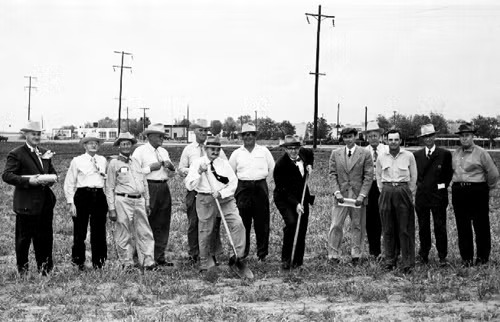
Rural electricity was a dream of rural homeowners in the Childress, Kirkland and Tell areas. This dream became a reality by the executive order of President Franklin D. Roosevelt that created the Rural Electrification Administration (REA) in 1935. As other rural communities in the nation were learning of the low-cost loans available and began working to electrify their rural farm homes, a committee of nine men in the local area came together to write the Articles of Incorporation of Gate City Electric Cooperative, Inc. Signing these articles on December 10, 1938, were: Leo Inman, Wilbur Williams, J.C. Jarrell, E.J. Groseclose, H.B. Smith, E.N. East, C.W. Alverson, F.P. Douglas and Roy Perkins.
These nine men would serve as the organizational committee of the Cooperative. At their first organizational meeting on December 17, 1938, held at 300 North Commerce Street in Childress, Leo Inman was elected chairman and H.C. Jarrell was chosen as secretary. This committee immediately began the work necessary to secure a loan from the REA. Nearly two years later, the membership gave authorization to borrow $1,500,000 from REA to finance the construction, acquisition and operation of electric generating, transmission, distribution and service.
The first REA note for $218,000 was signed July 9, 1940, to provide electric service to approximately 576 members in Childress, Cottle, Hall and Hardemen counties. The first contract for construction was recommended by Carl C. Cox Engineer and awarded to Richards and Mullinix of Oklahoma City, Okla., for $138,575.75 on August 5, 1940. Members would pay a membership fee of $5 and pay a bill of at least $2.45 per month regardless of the number of kilowatt-hours they used.
Two months into the building project, J.B. Morris resigned as project superintendent and R.A. Yarbrough was selected as the replacement. Yarbrough served as superintendent and later as cooperative manager until 1976. He was granted a brief leave in 1943 to be employed by the Childress Air Force Station Bombardier School. Upon his retirement in 1976, James C. Driver was hired to replace Yarbrough as manager and held that position until the point of merger with South Plains Electric Cooperative in 2000.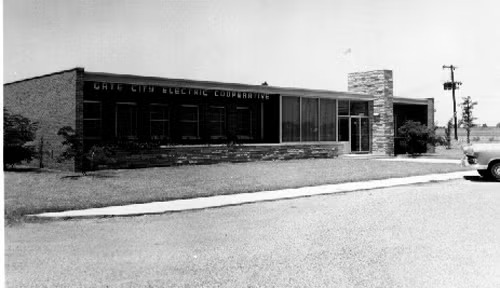
Business for the Cooperative was conducted from a building owned by Security Investments Company at 313 Commerce Street in Childress, until November 4, 1940, when a one-year lease contract with Bill Ross was signed for office space at the corner of Avenue D and 3rd Street NW for $40 per month. These facilities were used until property was purchased on September 22, 1947, from Panhandle Compress & Warehouse Company for $4,000. Two barrack buildings were purchased from War Assets Administration and used as warehouse and temporary office facilities until a permanent office building was built. The decision was made in April 1952 to employ an architect and take necessary action to secure a loan from the REA to build an office. An additional $100,000 was requested from REA to finance the construction of an office building, warehouse and garage facilities, and to purchase office furniture and equipment.
By February 1941, an additional $70,000 was borrowed to construct 70 miles of line to serve another 158 new applications. In March of that same year, a supplemental power contract with West Texas Utilities Company was established as a supplement to the original power contract dated September 18, 1940.
The first electric appliance purchased in February 1941. It was a one-can milk cooler used as a display model to encourage purchases by other members. Next was the purchase of an electric feed mill under the direction of the REA. It also was a display to encourage members to purchase feed mills. The first contract for appliances was granted to Westinghouse Electric & Manufacturing Company. Cooperative appliance and finance committees were appointed to set prices and determine credit to be extended to Cooperative members. The Cooperative later executed an educational campaign highlighting the many marvels of electric appliances in an effort to increase electric use by the membership.
Finally, by May 31, 1941, the first annual meeting of the growing membership was held in the district courtroom of the Childress City Courthouse, but those present in person an represented by proxy did not constitute at least 15 percent of the membership. The meeting was rescheduled for July 5, at which time the first board election was held. Those elected were: F.P. Douglas, Roy Perkins, C.W. Alverson, H.B. Smith, Tom Cannon, G.W. Jenkins, H.C. Jarrell, F.M. Kyle and Wilbur Williams. Officers elected were: Wilbur Williams, president; C.W. Alverson, vice president and H.C. Jarrell, secretary-treasurer. Total membership on July 5, 1941, was at 362. By 1950, the membership had grown to 1,472.
Gate City merged with South Plains Electric Cooperative in 2000.
On May 11, 1935, and pursuant to the authority of the Emergency Relief Appropriation Act of 1935, President Franklin D. Roosevelt established the Rural Electrification Administration (REA) by an executive order. Under this order, a sum of $75,000 was allocated to the new agency for administrative expenses.
Morris Llewellyn Cook, an engineer who had spent many years researching and investigating the need for rural electrification, was appointed as the first administrator for the REA.
On May 20, 1936, REA was passed making it a permanent agency of the Federal Government. A loan program was established making available long term, low interest loans to power companies, municipal electric systems, or electric cooperatives for extending electric service to rural areas and establishments not presently receiving central station electric service (electricity produced by large generating plants and delivered via wires to consumers). Few utility companies or municipal electric systems availed themselves of these loans because the expected revenue from the rural areas was much lower than from the cities, towns and urban areas. This left only one avenue for the rural dwellers. They formed their own electric system in the interest of service rather than profit.
The rural areas of the South Plains of Texas fell in this last category. There were approximately 2,700 farms in Lubbock County in 1937. Fewer than 30 of these were served with central station electric service. There were three incorporated towns and three unincorporated villages in the county that had electricity, as well as a few farm homes adjacent to them.
As early as 1936, several small groups of farmers became interested in the REA program. In 1937, a county-wide effort was started to electrify the rural areas. This effort coincided with interests shown in neighboring South Plains counties. There is little information left of these efforts before the time South Plains Electric Cooperative incorporated in late November 1937. This information was collected from persons who worked toward getting electric service during those first days; from correspondence and documents in the Cooperative's files; from the files of the Cooperative's first attorney, L.A. Howard, now deceased; from the files of the Cooperative's first engineer, H.N. Roberts of Lubbock, Texas, and from the Texas Tech University's file of local newspapers for the 1936-1937 period.
Image
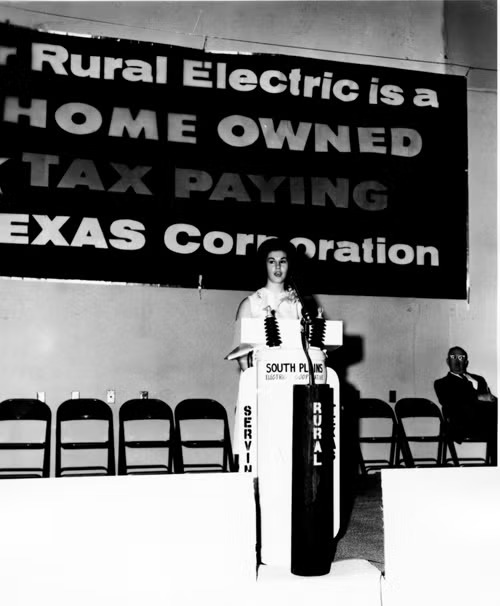
The first definite record that could be found of South Plains farmers trying to get electricity through the REA loan program was a letter from E.A. Manning, of Lubbock, writing to REA in Washington to request complete information on rural electrification. Mr. Manning's letter was dated September 30, 1936, and was answered on October 15, 1936, by N.L. Harfield, chief correspondent of the newly formed government lending agency. Harfield's letter to Mr. Manning included instructional literature about applying for a loan and accomplishments of REA. One interesting thing noted in the letter to Mr. Manning is the following excerpt: "To be financially self-supporting, a project should include at least twenty-five miles of line with an average of three customers per mile."
Although Mr. Manning, the first known correspondent, lived in Lubbock, he owned farm property in Southwest Lubbock County. At or about this time, a group of farmers north of Lubbock, in the New Deal community, had become interested in the REA program. Two of the leaders of the New Deal group were S.S. Allcorn, a farmer, and W.O. Fortenberry, a gin owner and farmer. All correspondence between the New Deal group and REA have since been destroyed, making it impossible to determine the exact date they first attempted to get a REA loan.
The Manning group, southwest of Lubbock, submitted an application for funds to REA on November 17, 1936, to build 27 miles of line to serve 126 customers. The New Deal group submitted an application about the same time to serve approximately the same size project. Mr. W.M. Ross, first president of the Cooperative, and a Mr. J.T. Collie, a print shop owner and land owner, were also active in the southwest group.
There may have been some correspondence between a group of farmers in the Roosevelt Community in east Lubbock County and REA but this could not be definitely verified. M.H. Vardeman, a farmer in that community, and Roy Monk, the vocational agriculture teacher, were early workers in the movement, but their main contribution was early in 1937.
No loans were made in response to these 1936 applications. REA policy was becoming better established and its direction changed from the pursuit of small projects to larger undertakings that could support administrative organizations with paid managers, linemen and service personnel. However, those first small applications had stimulated some rural interest that made development on an area-wide basis easier to pursue the following year.
During the last days of 1936 and early in 1937, a most significant movement took place that materially hastened rural electrification in Lubbock County, the heart of the South Plains. A move started to organize Grange chapters in various communities. Rural electrification was the first project attempted by the local chapters. County chapters were also formed, giving liaison between local chapters.
The first record of Grange chapters being organized in Lubbock County was January 12, 1937. By February 11, 1937, four chapters had been organized in Slaton, Southwest Ward, Shallowater and Roosevelt.
Birth of a Cooperative
Although South Plains Electric Cooperative did not receive a charter or become a Texas corporation until late in 1937, it had its birth on Monday night, March 8, 1937, in the Lubbock Junior High School. There was a county-wide Grange meeting with about 70 members present. A temporary committee was elected and served until the organization was incorporated. Committeemen were as follows:
- C.E. Lilley, Slaton
- C.Z. Fine, Posey
- Z.L. Evans, Shallowater
- W.O. Fortenberry, New Deal
- M.H. Vardeman, Roosevelt
- W.M. Ross, Southwest Ward
- Lewis Countess, Idalou
- A.B. Allen, Cooper
- N.A. Payne, Carlisle
The Committee chose "South Plains Electric Cooperative Company" as the name of the corporation. All committeemen, except Fortenberry, Evans and Payne later became incorporators and charter members of the Cooperative.
On April 27, 1937, H.N. Roberts submitted an application for a REA loan with supporting maps and data to the committee for approval. The application showed 1,081 survey blanks signed by Lubbock County farmers pledging to take electric service. The applications showed Lubbock County to have 2,600 farms without electric service. The application proposed the construction of 430 miles of electric lines to serve the 1,081 signers. REA acknowledged receipt of the applications on May 10, 1937, but informed the group that REA was out of funds until the next fiscal year beginning July 1, 1937.
Due to fund restrictions from REA, the application was revised to reflect needs that didn't exceed the $100,000. A contract proposal was negotiated with the City of Lubbock to purchase power from the municipal electric system. Finally, on November 5, 1937, John M. Carmody, administrator of REA, notified the committee that $100,000 was allocated, opening the way for electricity to South Plains farms. In many respects this was impressive--scarcely a year from the time some interest had been shown in the area, and only six months from the date of the first county-wide effort. All this was accomplished with no outlay of money by the people except personal time and expense. Too much cannot be said for the financial risk assumed by the engineer and the attorney, and the thankless time spent by agriculture teachers, farm organizations, committeemen, and, finally, the farm workers who did almost all the legwork without thought of any compensation other than the chance of electricity.
Certainly the allotment did not end the work to be done. Right-of-way easements had to be secured, applications for service had to be obtained from each applicant along with a $5.00 membership fee. Lines had to be designed, staked and bids taken for actual construction. However, the task now had new meaning.
A charter was granted by the State of Texas on November 27, 1937, and to satisfy the Texas Electric Cooperative Inabling Act, the name was changed to South Plains Electric Cooperative, Inc.
The $100,000 was for building approximately 108 miles of line to serve about 298 subscribers. The first line of the Cooperative was energized on July 14, 1938, and this was only on a temporary basis from 8:00 a.m. to 5:00 p.m. Cooper Rural High School was then being built, and ironically, service was used for power saws, rather than for farm and home use. On August 5, 20 miles of line was permanently "cut hot" serving 63 consumers. All work was completed by the contractor on August 12. By August 27, 137 miles on the first section was energized, serving 266 members.
South Plains Electric Cooperative is about families coming together as a community to build their own electric utility.
Local families forging a better life for themselves.
The same local families that were ignored by the other electric utilities.
These pioneers chose the not-for-profit cooperative business model because it was service they cared about, not profits.
We owe these pioneers a tip-of-the-hat for their vision, their resolve and their sound business judgment.
Last year, we paid tribute to our member-service vision as the Cooperative celebrated its 80-year anniversary.
We talked about our rich history and how, even today, the Cooperative is still a low-cost provider of electricity with unmatched member service and vital community support.
This year, we have three other history lessons to share with you.
These history lessons highlight how the leaders of South Plains Electric Cooperative protect your best interests in legislative and political realms.
We are your source for power, but we also want to be your source for information.
So the first lesson explains why, in the 1970s, South Plains Electric fought to protect the investments members made in their new cooperative utility.
And grow we did!
From 1975 to 1998, the Co-op grew by 54% to just over 29,000 meters.
During that same time period, we also joined forces with neighboring co-ops to form our own wholesale power cooperative—Golden Spread Electric Cooperative.
Owning your wholesale power supplier gives you control over prices and planning. It gives you stability and assurance that future needs will be met.
Our second history lesson revolves around what happened in the late 1990s when Texas was working to deregulate the electric utility industry. The investor-owned utilities and large industrial users wanted an open market for electricity providers.
Texans were already enjoying some of the lowest electric rates in the whole country, so once again, your Cooperative leadership jumped in to the discussion and worked tirelessly to protect members’ best interests.
Much of this discussion will seem familiar to you. Not because you remember what happened in the 1990s, but because of what is currently happening.
The topic of customer choice is currently being discussed in the Lubbock area as LP&L works to move a portion of their customers to the ERCOT market.
With the help of your Co-op leaders back in 1999, the areas outside of ERCOT were carved out of deregulation, and for good reason, as we’ll explain.